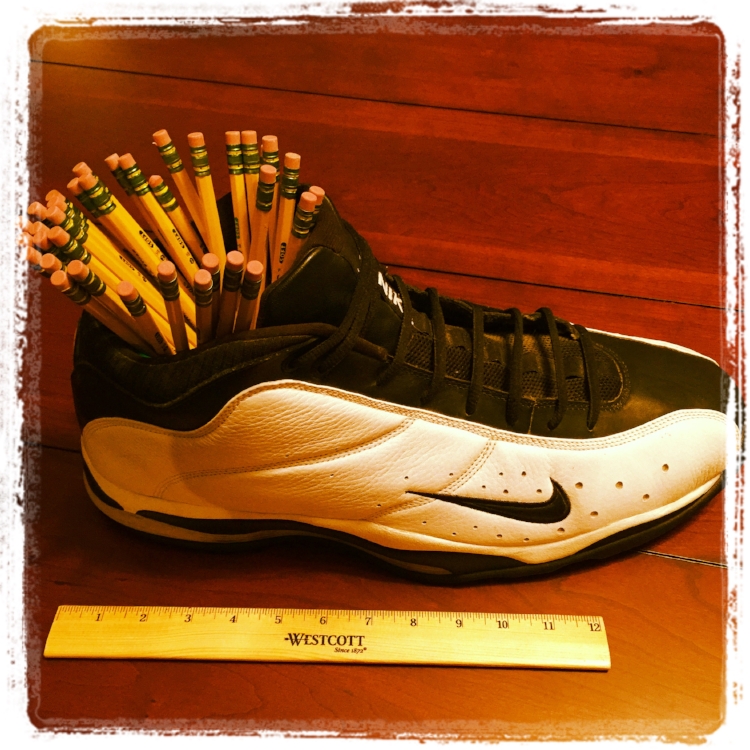


Looking for gift ideas for the math teacher in your life? The handy guide of 29 different gift ideas should get you on your way.


Comparing Quantities using Percentages
In this section, we are going to be comparing Quantities. The formula we use is very similar to part = percent x whole, but with a small tweak. Instead of “part” we are using “Quantity.”

When solving these percentage problems, we will solve as a one step equation. The nice thing about this method is that you just memorize one thing instead of three. As students do these problems they will begin to notice short cuts they can use to solve problems quicker.
We want the students to discover these short cuts on their own. By doing this, students will have a much greater chance of retaining this information.
This will be hardest for parents (and even teachers) because we become so used to using the quicker short cuts. In the long term it will benefit the students with a greater depth of understanding of percentages

In this blog I’m writing about how I model percentages in my class. There are many parts of Mathematics that students will never use in their life once they graduate, but Percentages will be one of most used regardless of profession. Because of its importance, I like to take a little extra time to make sure that students have a deep understanding of this valuable skill.


In the world of quadrilaterals, the formula to find area of Trapezoids is one of the most feared by middle school students. Perhaps it’s the use of parentheses. If you throw these bad boys into a problem it’s sure to create a certain level of anarchy. Possibly it’s the use of the numbers 1 and 2 written below and to the right of the two bases (b) in the parentheses.
Regardless of of the reason, the formula for Area of Trapezoids has caused many kids to surrender without so much as a fight.
The kicker is that the formula is not difficult to solve. In this blog we will look at a couple of the key terms, dissect the formula, give three examples of finding area and show you a three ways to model finding the area.

Finding area of Triangles can be challenging for students and parents alike. In this article, we break down the formula(s), show the reasoning behind area formulas, model and give examples of calculation the area.


So it's getting close to Christmas and your are still looking for gift ideas for that special Math teacher or math fanatic in your life. Don't fret, we got you covered with 45 different ideas for that special mathematical person in your life.
We have divided the gift ideas into 6 different categories: 1) Clothing & Accessories 2) For the Classroom 3) Books 4) Around the House 5) Math Fun 6) Productivity and 7) Stocking Stuffers

I used to open up the school year with some nice get to know you activities. For example, I might randomly partner students together and have them interview each other. After the students asked each other a few questions, they would introduce their partner to the rest of the class. This was always a nice way to ease into the school year and get to learn a bit about the kids.
As much as I (and the kids) enjoyed these opening day activities I always felt something was lacking. There seemed to be this disconnect with these activities and math. (Also, it seemed like every teacher in the building was doing some variation of this. So the students were doing this all day long. The novelty was lost by the time many got to me.)
Last year I tweaked how opened the school year.



The struggle is Real
It's that time of the year. It is time to find a gift for people that you have no idea what they want. If the person you are looking for likes math we can help. Below is a baker's dozen random math gift ideas. Think of these items as "affordable mathematical luxuries."
"Why was 6 afraid of 7? Because 7, 8, 9."
Let's face it, math can be very boring for many students. No better way to spice up a lesson than with a well place math joke. I know what you are thinking, "There are math jokes?" Yes there are! Below is a collection of a few links to sites that have a variety of jokes.

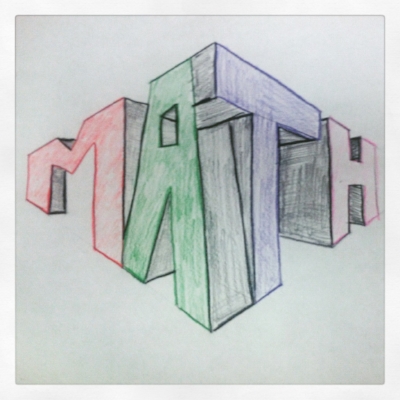
Creating 3 Dimensional Drawings
One of my favorite activities each year is using scale factor to create three dimensional drawings. We do this activity when we are studying Unit Rates. There are a variety of reasons why this is one of my go to lessons.
Hands On
This activity gives students the chance to create something. The act of drawing, measuring, & designing is a nice change of pace from the usual worksheet avalanche. The actual act of creating this object allows students to see the relationship of sides all changing proportionally.
Creativity
This lesson gives students the opportunity to showcase their creative/artistic side. We have some basic guidelines, but in general students are free to design what appeals to them.
Visual
Many students are visual learners. For some students it easy to see difference between an object drawn to scale and an object that does not have a constant proportionality.
Connections with other classes
Art, Social studies (maps), industrial tech, and computer science classes are some of the classes that we are able to show a connection with. For example, our art classes use one point perspective drawings which share a ton of similarities with our scale drawings.
Differentiate
The activity allows you to increase (or decrease) the difficulty. For example, if you have a student that is struggling you can use a very simple shape such as the letter "L" or use a very easy scale factor such as 2. If you want to increase the intensity you can have students measure everything in inches (not centimeters) or require a very unusual scale factor such as 3/8 or 1.75.
THE PROCESS


If you are involved in education you probably have heard of Teachers Pay Teachers (TPT). If you have ever tried to pin something educational on Pinterest I know you are aware of TPT. TPT was started by Paul Edelman, a New York teacher, in 2006. Today Teacher Synergy (the company behind TPT) has evolved into a major disruptor in the world of education.
Teachers Pay Teachers is a marketplace for teachers to buy and sell different educational material. Initially, TPT was a really cool place for teachers to make some extra cash on the side but it has turned into a major game changer in the world of education.
Five years ago only one or two teachers at my school ever heard of Teachers Pay Teachers. Today, TPT is just part of normal conversation in the teacher lounge or during staff professional development. There have been multiple times that teachers will laugh when they realize that they downloaded the same product from TPT.
The Impact of Teachers Pay Teachers is far greater than simply making some money for selling a few worksheets. TPT is helping fuel major change in the world of education. Below are few of the ways.
Building
Because of TPT, teachers are now building different products. The act of building gives teachers a deeper understanding of the content they are teaching. We are striving for students to improve their problem solving skill, but teachers also need to work on this skill. As teachers try to create new products it gives them a feel for what their students are going through.
Creative
If you are going to sell things on TPT, you can not just create boring run of the mill worksheets. You need to think differently. You need to make products that are unique and get students (and teachers) excited. What can you do to make a fraction lesson fun and challenging? Can you transform a traditional lesson into a hands on lesson? What about a game?
The process of being creative forces you to make the ordinary extraordinary.