

How I'm starting the school Year.
I used to open up the school year with some nice get to know you activities. For example, I might randomly partner students together and have them interview each other. After the students asked each other a few questions, they would introduce their partner to the rest of the class. This was always a nice way to ease into the school year and get to learn a bit about the kids.
As much as I (and the kids) enjoyed these opening day activities I always felt something was lacking. There seemed to be this disconnect with these activities and math. (Also, it seemed like every teacher in the building was doing some variation of this. So the students were doing this all day long. The novelty was lost by the time many got to me.)
Last year I tweaked how opened the school year.
I used to open up the school year with some nice get to know you activities. For example, I might randomly partner students together and have them interview each other. After the students asked each other a few questions, they would introduce their partner to the rest of the class. This was always a nice way to ease into the school year and get to learn a bit about the kids.
As much as I (and the kids) enjoyed these opening day activities I always felt something was lacking. There seemed to be this disconnect with these activities and math. (Also, it seemed like every teacher in the building was doing some variation of this. So the students were doing this all day long. The novelty was lost by the time many got to me.)
Last year I tweaked how opened the school year.
I would still do surveys, but with a more organized purpose. I would make up the surveys with the end goal of the students graphing the results of their surveys.
Normally graphs/charts get shoved to the end of the year (sometimes it gets totally left behind because of snow days). This is such a bummer because there are so many activities during the year that are conducive for using, reading, & analyzing graphs. For example, this year I am planning on a year long Stock Market lesson. Needless to say, graphs are sort of a big deal in this world.
The following are a few of the advantages of opening the school year with this survey/graphing lesson:
- You would get to learn about the students as a group/class/grade level.
- While students are creating graphs you have the opportunity to interact 1-on-1 with different students which helps to get to know the student.
- Lots of hands on activities.
- It's not a stressful environment.
- Students would be able to move around instead of stuck in their seat the whole period.
- Students would be able to interact with other students.
- Students would have freedom to be creative.
- Students get to collaborate with each other
- As a teacher you get to cover 7 different graphs (bar, line, circle, scatter, stem-n-leaf, histogram, box-n-whisker), median, coordinates, angles, intervals, number lines, & degrees of a circle.
- Reading and analyzing graphs.
- You get to cover an area that many times doesn't get covered, or gets just minimal coverage.
- You can use graphs with a variety of units (graphing equations/inequalities for example) during the year.
Below are the steps I took:
STEP 1 - The Survey
The first thing I did was to create a survey. When creating questions I focused on questions that I could use to create different types of graphs and different ways to group students.
(QUESTIONS: gender, class period, how much do you like math (scale of 1-10), how good are you at math (scale of 1-10), grades at Lakewood (k,1,2,3,4,5,6), In the band, sports played, social media, Height, and arm span).
For example, Line Graphs are a bit of a challenge because of the time element needed. To get around this I asked the students to circle the different years they attended our school. This would give us the element of time (grades k-6) that we could use on the x-axis.
Two of the questions (gender & class period) would allow students different ways to group the information.
STEP 2 - Gather and Sort data
Next, students would need to tally up the results of these different survey questions. At times I will let the students figure out how to gather and organize the results. Usually this is chaos. Sometimes chaos is good, but with most students this just leads to anarchy. As a result, I will usually guide/teach students how we can group and record the results of the surveys.
I make sure that the data is split between boys and girls. Because each class is looking at their results, the data is already divided by class period.
STEP 3 - Bar Graph
I like to start with bar graphs because they are the easiest and are the ones the students have been using these for years. This is the sequence I follow when working with bar graphs:
- Lesson on bar graphs
- Parts (x & y axis, title, labeling x & y axis, intervals of y axis, and categories of x axis)
- How bar graphs can be deceptive (using different intervals and skipping intervals)
- Different ways to design bar graphs (double bar graphs, stacking bar graphs, vertical vs. horizontal)
- Reading Bar graphs - I will create a power point with a couple of bar graphs. I will show these graphs to the class and ask them what information they know from looking at this graph.
- Make a couple of basic bar graphs as a class (ex. I might make up info about number of dogs and cats in each class ) period. I show students different ways to group data (by class, gender/class, all students, all students broken down by gender, etc.).
- Finally students can make a bar graph of student gender and/or band participation.
STEP 4 - Circle Graph
The next graph I like to use is the circle graph (aka the Pie Chart). Most students are familiar with reading this graph but are weak at making it. In younger grades, students usually will estimate the parts of a circle graph.
The number one struggle for many students is not the math (it's still a struggle), but actually the act of making a circle with a compass. I also opt for the Angle Ruler instead of the Protractor.
- Lesson on circle graphs
- circles are 360 degrees
- Converting the numbers in a survey to degrees in a circle graph.
- I teach 360 divided by number of responses in a survey = degrees of each response. I will show students different ways to round numbers and their impact on the graph.
- How to use the Compass
- How to use the Angle Ruler (to measure and create parts of the circle graph)
- Reading circle graphs -Just like with bar graphs - I will put a couple samples on a power point and share with the class. Together we will discuss what we know about this graph.
- Make a couple of basic circle graphs. For the examples I always (at least at first) use numbers that are multiples of 360 such as 180, 120, 90 etc.
- Finally students can make a circle graph of different sports that students are in. (boys only, girls only, boys/girls combined etc.)
STEP 5 - The Box-and-Whisker Graph
For most of my 7th grade students this is a new thing. It's got a goofy name (I just assume some lady that loves cats named this thing) and it looks a bit strange. Sometimes kids can be a bit apprehensive because of how it looks. I spend a bit more time on examples of the Box-n-whisker just because it is new and has has a lot of different parts.
- Lesson on Box-and-whisker graphs
- Parts of the Box-and-Whisker
- Extremes, Quartiles, median, number line, box, whiskers
- The four parts of Box-and-Whisker that are each 25%.
- Parts of the Box-and-Whisker
- Reading Box-and-Whisker graphs -I usually start with a double Box-and-Whisker Graph sample. For example, I usually will have two "random" classes and their quiz scores. The first teacher (Mr. Smith for example) I will make sure his extremes are both larger than the other teacher's extremes (let's call her Mrs. Jones). I will make the quartiles and median for Mrs. Jones larger than Mr. Smith's. Actually I line up Mrs. Jones' median with Mr. Smith's Upper Quartile and her Lower Quartile with his Median. This leads nicely to a discussion about which class did better on the quiz. You can make an argument for each class.
- Next I have the students make different box-and-whisker graphs. To make a Box-and-Whisker you are finding three Medians: Whole, smallest half and largest half. There are four different situations that occur:
- Total is an odd amount of numbers and halves are odd an amount of numbers
- Total is an odd amount of numbers and halves are an even amount of numbers
- Total is an even amount of numbers and halves are an odd amount of numbers
- Total is an even amount of numbers and halves are an even amount of numbers
- Finally, students can make a Box-and Whisker Graph of the total number of students that are good at math. ***Make sure that the extremes, quartiles and medium are five different numbers***. If you do have duplicate numbers you will want to look at either "students that like math," "student heights," or "student arm spans."
STEP 6 - Line Graph
Line graphs are another graph that students have used. A key focus is the element of time (minutes, days, weeks, years) on the x axis. The biggest mistakes I are usually intervals not being consistent (x and y axis) and when plotting points, not using the grid lines to help plot the points.
- Lesson on Line graphs
- Parts (x & y axis, title, labeling x & y axis, intervals of x and y axis, and some element of time on the x axis)
- Having consistent intervals on x and y axis
- Showing how to correctly plot the points on line graph.
- Show how bar graphs can be deceptive. For example, the greater the intervals on the y axis the smaller the bars (the smaller the intervals the greater the size of the bars.)
- Reading Line graphs - I will create a power point with a couple of line graphs. I almost always use a graph of a companies stock price over the years (I look for a company with a lot of price swings and that the kids like.) I will also introduce double line graphs which compare two different items (such as two different companies).
- Next, I'll have students complete a couple of easy line graphs (usually multiples of 5 or 10)
- Finally, I will have the kids make line graphs of the number of students attending Lakewood over the past 7 years. If I want, I can make a line representing each of the classes, boys and girls or my students vs. the other math teachers students.
STEP 7 - Histogram
Histograms look a lot like bar graphs. Most people would just assume they are same. In my 7th grade classes, very few of my students have ever heard of a histogram. The biggest difference between a bar graph and a histogram is the x axis. The bar graph will show categories (like types of colors, favorite pets etc.) while the histogram will show a sequence.
- Lesson on Histogram
- Focus on how the Bar and Histogram are nearly the same with the exception of the x axis which the Histogram uses some type of a sequence (such as time, weight, ages).
- Parts
- x and y axis, intervals, labeling each axis, bars (bars - which must touch)
- Reading a histogram
- Reading a histogram in many ways is more like reading a line graph, especially if the sequence on the x axis is an element of time. Like the other graphs I will have a couple examples to look at.
- I usually just have one simple histogram for students to do before we work on the survey histogram.
- Students will make a histogram of the number of students attending Lakewood each year. (yes I know it's the same topic as with the line graph).
STEP 8 - Stem-n-Leaf Graph
The stem-n-leaf graph is really ideal for gathering and recording large amounts of data. The advantage of the graph is that you only need to record half the numbers. It also can be a nice graph to compare to amounts side by side.
- Lesson on Stem-N-Leaf
- Show students how the numbers drawn vertically represent the tens place. Only the number found in the ones place is written next to the vertical numbers. make sure numbers are written in numerical order (left to right on the right side of the stem and right to left if written on the left side).
- Parts of the Stem-n-leaf graph
- Stem, leaf (numbers written horizontally), a second stem if using a double stem-n-leaf and title
- Reading a Stem and leaf graph
- Reading a Stem-n-Leaf is very different from other graphs. A single Stem-n-leaf you read like a book - top down and left to right. In the case of a double steam-n-leaf graph you read the "leafs" on the left, top down, BUT right to left.
- I will do a couple (one single and one double) Stem-n-leaf graphs with the students using basic numbers. In addition, I will show how how to write numbers that are over 100.
- Students will make a a double Stem-n-leaf graph using the height and arm span of 7th grade students)
STEP 9 - Scatter Plot
Even though the Scatter Plot is not a required graph to teach it doesn't take long to teach and it's great at showing trends/patterns.
- Lesson on Scatter plots
- The biggest thing that is new for the scattered plot is reading coordinates (x,y). I really try to focus on having students use the vertical and horizontal lines when plotting points.
- Parts of Scatter Plot
- The set up of the scatter plot is similar to bar, line, or histogram.
- Reading Scatter Plot.
- The biggest thing is the relationship between the x and y axis.
- How to read - x first and then the y
- looking for trends/patterns
- When looking at the graph we are looking for a pattern for example...
- If you work more (x axis) the y axis (money) also increases.
- If you run more (x axis) your weight (y axis) will decrease.
- sometimes there is now trend (waffles you eat and your height)
- When looking at the graph we are looking for a pattern for example...
- The biggest thing is the relationship between the x and y axis.
- As with the other we will do a couple of basic examples
- Students will use their height and arm span to see if there is a correlation between their height and arm span. I will have one massive coordinate grid which all students will plot their coordinate.
- Next I will draw a line (not quite a fitted line) that connects all coordinates with the same Height and Arm Span. Students will discuss how their coordinates compare to the line (most are on or below). Finally, I will plot the coordinates of NBA players preparing fore the NBA draft. Students will notice how most (if not all) the players are located above the line. We will then discuss how this is an difference in height and arm span is a huge advantage for basketball.
At the very end of the lesson we have students brainstorm all the different things about their class that they can determine from reading the graphs. This is a nice chance to overlap with Language Arts. We put the results on a hallway bulletin board (it's big) to share with our fellow classmates.

Making 3D Shapes and Similar Objects using Scale Drawing
Creating 3 Dimensional Drawings
One of my favorite activities each year is using scale factor to create three dimensional drawings. We do this activity when we are studying Unit Rates. There are a variety of reasons why this is one of my go to lessons.
Hands On
This activity gives students the chance to create something. The act of drawing, measuring, & designing is a nice change of pace from the usual worksheet avalanche. The actual act of creating this object allows students to see the relationship of sides all changing proportionally.
Creativity
This lesson gives students the opportunity to showcase their creative/artistic side. We have some basic guidelines, but in general students are free to design what appeals to them.
Visual
Many students are visual learners. For some students it easy to see difference between an object drawn to scale and an object that does not have a constant proportionality.
Connections with other classes
Art, Social studies (maps), industrial tech, and computer science classes are some of the classes that we are able to show a connection with. For example, our art classes use one point perspective drawings which share a ton of similarities with our scale drawings.
Differentiate
The activity allows you to increase (or decrease) the difficulty. For example, if you have a student that is struggling you can use a very simple shape such as the letter "L" or use a very easy scale factor such as 2. If you want to increase the intensity you can have students measure everything in inches (not centimeters) or require a very unusual scale factor such as 3/8 or 1.75.
THE PROCESS
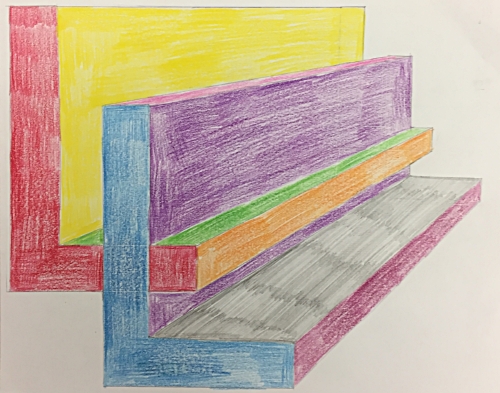
Creating 3 Dimensional Drawings
One of my favorite activities each year is using scale factor to create three dimensional drawings. We do this activity when we are studying Unit Rates. There are a variety of reasons why this is one of my go to lessons.
Hands On
This activity gives students the chance to create something. The act of drawing, measuring, & designing is a nice change of pace from the usual worksheet avalanche. The actual act of creating this object allows students to see the relationship of sides all changing proportionally.
Creativity
This lesson gives students the opportunity to showcase their creative/artistic side. We have some basic guidelines, but in general students are free to design what appeals to them.
Visual
Many students are visual learners. For some students it easy to see difference between an object drawn to scale and an object that does not have a constant proportionality.
Connections with other classes
Art, Social studies (maps), industrial tech, and computer science classes are some of the classes that we are able to show a connection with. For example, our art classes use one point perspective drawings which share a ton of similarities with our scale drawings.
Differentiate
The activity allows you to increase (or decrease) the difficulty. For example, if you have a student that is struggling you can use a very simple shape such as the letter "L" or use a very easy scale factor such as 2. If you want to increase the intensity you can have students measure everything in inches (not centimeters) or require a very unusual scale factor such as 3/8 or 1.75.
THE PROCESS
The Build Up
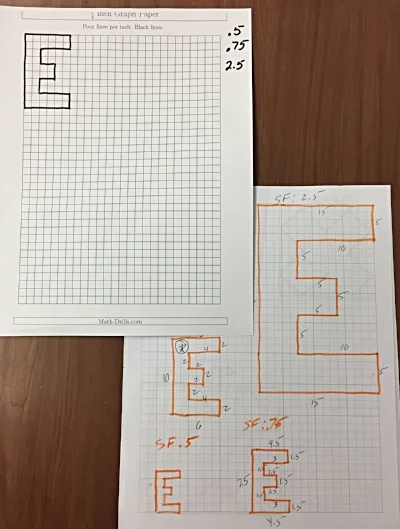
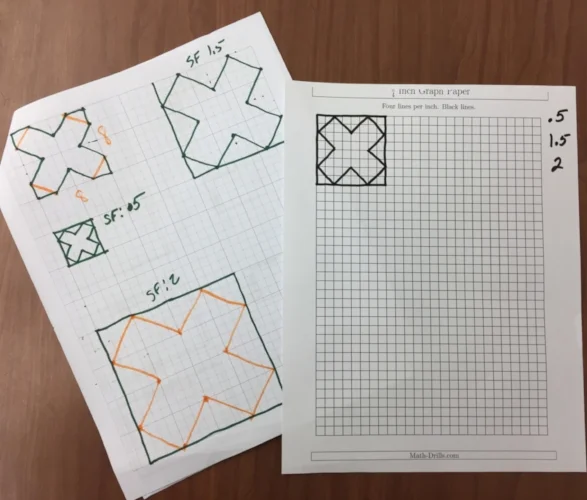
One of the first things we do is to talk about Scale Factor. We want the students to understand that when we are enlarging (or shrinking) an object all the edges of this object are increasing (or decreasing) at a constant rate (proportion). We do this by having a worksheet with similar objects and their measurements. Students will then find the rate of increase or decrease (Scale Factors less than one = smaller, greater than one = larger).
Next, we give the students a grid paper with a shape on it. We first start with a basic rectangle then move on to more complex shapes. Above are two of the sheets we used this year. We give the students a few different Scale Factors we would like them to use to create a similar object. You can see on the "E" paper on the left we used Scale Factors of 0.5, 0.75 & 2.5.
Usually after doing a few of these the students begin to understand how all the edges are increasing at the same rate.
Model the Process
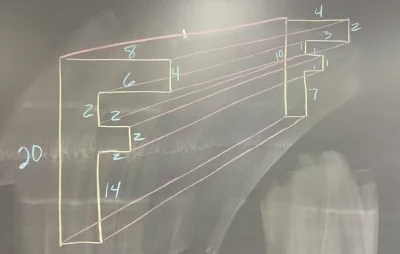
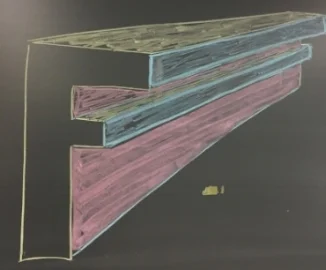
The first thing I like to do is to show them an example. I start by drawing a random object. In the example above (left) I used the letter "F." I like to use a letter with a lot of edges because it helps to show how all the different edges shrink (or enlarge) at a constant rate.
After I draw the original "F" I then draw a second letter "F" and connect all the corners. I like to have the students connect ALL the corners, even the ones that will be covered once we color. I have to students lightly draw their lines, but I like to see the lines after they have been colored over.
Next, I color in the different sides that would be visible. This is a real struggle for students to visualize. I try to color code my example to help the students to better visualize. In the example above right I use yellow for the tops, pink for the right side of the stem and blue for the right sides that stick out. (I realize this is not technical talk). The result is an object that has a three dimensional look.
Experiment with something Easy
I like the students to start with a very simple shape, such as a rectangle, to get a feel for the process. One of the most common mistakes is for a student to get in over their head on their very first object. After getting some experience with a simple shape it is time to move on to a more complicated shape.
Making your 3D object
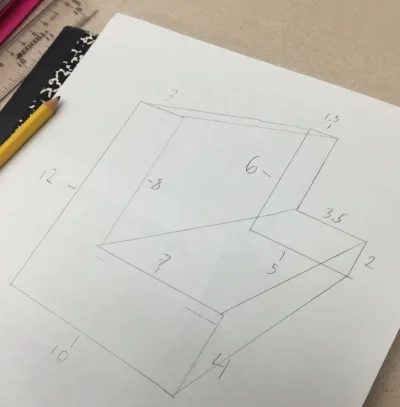
Once we feel like the students understand what we are trying to do we turn them loose.
Students select a shape that they like. (We have students stay away from rounded edges until we feel like they totally grasp the concept). The students will draw the original object and then a second similar object. We usually let the student pick their own scale factor (almost always 2 or 1/2), but at times we will select a scale factor when we want to challenge the students.
Once students have drawn these two similar shapes they connect the corresponding corners.
* As a side note: where you place the second similar object will change to look of your 3D object. This is a good thing to experiment with a basic shape.
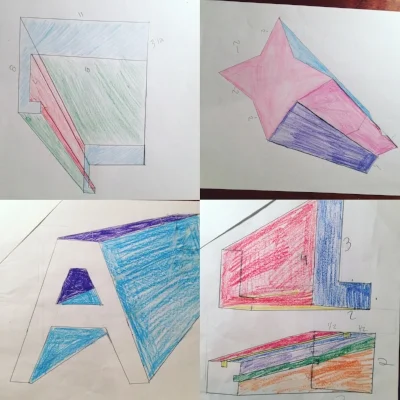
Once the two shapes have been connected it is time to color. This is a great way to determine if students can visualize what sides can be seen and which ones are blocked or partially blocked. When coloring, it is helpful to use different colors to help each side stand out. Another thing to help the shape to really stand out is you trace over the visible edges with a pencil but to push down very hard to make darker lines.
Drawing a similar object using a scale factor
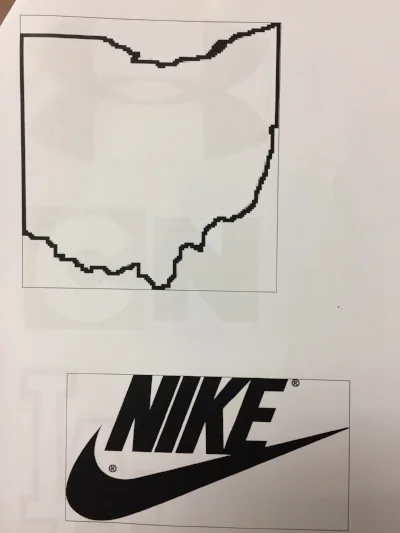
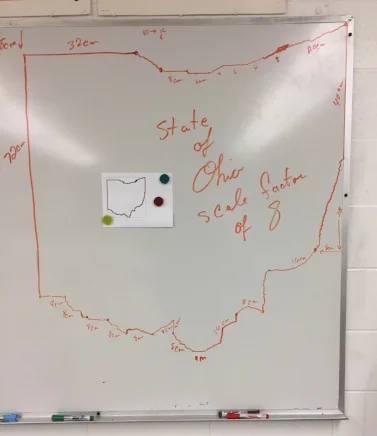
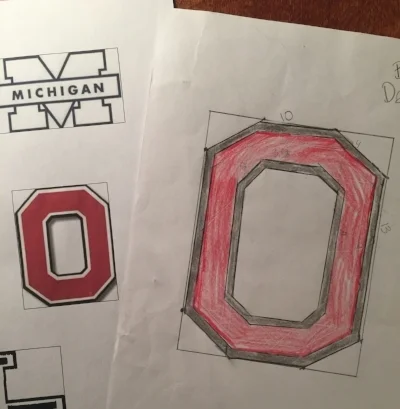
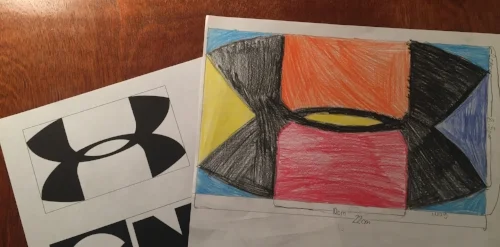
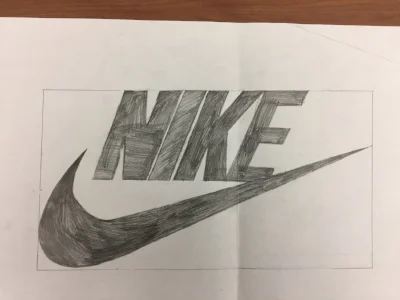
Another thing I like to do with scale factor is to have students draw an object to scale. We give students a packet of different shapes that they can select from. We have a collection of basic and challenging shapes to select from. One key thing we do to help the students is to to draw rectangles around the objects. Why? This gives the students something to help guide them.
In the example below, on the left we have a copy of the state of Ohio. Is my scale drawing of the picture of Ohio. On the original paper copy on the left the upper left corner is 1 cm below the corner of the rectangle. When I did the scale drawing of Ohio I used a scale factor of 8. As a result, I measured down 8 cm from the upper left corner of my rectangle.
Below are a couple of examples of students drawing similar objects using a scale factor.
Todd Hawk is a middle school math teacher and the Founder of the Land of Math LLC (www.landofmath.com). You can reach him at landofmath2@gmail.com or follow him on twitter: @landofmath2 and Instagram: @landofmath
Prang Power!

If you work at any school in America I sure you are well aware of the Box Tops for Education Program. It's a super program and provides a lot of great resources. At most school I've been to the Box Top program is done as a school wide fundraiser. This certainly makes sense, there is strength in numbers.
But what if you are a teacher and you are looking for an easy way to earn free items for your class? You don't want to do the Box Tops for just your class because that would undermine your schools efforts. It would be nice to find something that the other teachers in your building are not doing. The answer: PRANG POWER
What is Prang Power? Prang Power is an educational program created by Dixon-Ticonderoga the pencil company (which includes all Dixon, Ticonderoga, Lyra, & Prang products). Very few teachers are even aware of this program (I am the only person at our district). So how does this program work?
Step 1 - Sign up for the program
Signing up is easy and free. Just go to www.prangpower.com and sign up for the program. The whole process takes less than 2 minutes.
Step 2 - Collect UPC Codes
This is real easy to do at the start of the school year. Many of your students are going to have brand new boxes of pencils. Simply ask them if you can have their UPC codes. Most students are glad to get rid of the boxes.
Ask you fellow teachers. Just like the students, teachers are loading up on pencils, chalk and other school supplies at the start of the year. Make the rounds at your school. Again most of the teachers are happy to get rid of their boxes.
Check in with your administration (this includes the secretaries). Often your school will purchase large amounts of pencils for testing and general use. Just like the kids and teachers, they are happy to get rid of their boxes.
Bonus Points - You can earn bonus points from prang for different things such as mentioning Prang Products on your school supply list.
Step 3 - Mail in UPC codes
As you collect UPC codes you can mail them to the Prang Program. Each UPC code has a point value approximately equal to the suggest retail price. So a $5 box is worth about 5 points. Prang will keep track of your points as you send them in.
Once you have earned 300 points you can begin cashing in your points for pencils, art supplies and other items.
Step 4 - Cash in your points for free Product.
At the start of this school year we received nearly 500 free pencils as the result of this program and we are close to getting more!
Todd Hawk is a middle school math teacher and the Founder of the Land of Math LLC (www.landofmath.com). You can reach him at landofmath2@gmail.com or follow him on twitter: @landofmath2.
8 Reasons why Teachers Pay Teachers (TPT) is creating a grassroots disruption in education.
If you are involved in education you probably have heard of Teachers Pay Teachers (TPT). If you have ever tried to pin something educational on Pinterest I know you are aware of TPT. TPT was started by Paul Edelman, a New York teacher, in 2006. Today Teacher Synergy (the company behind TPT) has evolved into a major disruptor in the world of education.
Teachers Pay Teachers is a marketplace for teachers to buy and sell different educational material. Initially, TPT was a really cool place for teachers to make some extra cash on the side but it has turned into a major game changer in the world of education.
Five years ago only one or two teachers at my school ever heard of Teachers Pay Teachers. Today, TPT is just part of normal conversation in the teacher lounge or during staff professional development. There have been multiple times that teachers will laugh when they realize that they downloaded the same product from TPT.
The Impact of Teachers Pay Teachers is far greater than simply making some money for selling a few worksheets. TPT is helping fuel major change in the world of education. Below are few of the ways.
Building
Because of TPT, teachers are now building different products. The act of building gives teachers a deeper understanding of the content they are teaching. We are striving for students to improve their problem solving skill, but teachers also need to work on this skill. As teachers try to create new products it gives them a feel for what their students are going through.
Creative
If you are going to sell things on TPT, you can not just create boring run of the mill worksheets. You need to think differently. You need to make products that are unique and get students (and teachers) excited. What can you do to make a fraction lesson fun and challenging? Can you transform a traditional lesson into a hands on lesson? What about a game?
The process of being creative forces you to make the ordinary extraordinary.

If you are involved in education you probably have heard of Teachers Pay Teachers (TPT). If you have ever tried to pin something educational on Pinterest I know you are aware of TPT. TPT was started by Paul Edelman, a New York teacher, in 2006. Today Teacher Synergy (the company behind TPT) has evolved into a major disruptor in the world of education.
Teachers Pay Teachers is a marketplace for teachers to buy and sell different educational material. Initially, TPT was a really cool place for teachers to make some extra cash on the side but it has turned into a major game changer in the world of education.
Five years ago only one or two teachers at my school ever heard of Teachers Pay Teachers. Today, TPT is just part of normal conversation in the teacher lounge or during staff professional development. There have been multiple times that teachers will laugh when they realize that they downloaded the same product from TPT.
The Impact of Teachers Pay Teachers is far greater than simply making some money for selling a few worksheets. TPT is helping fuel major change in the world of education. Below are few of the ways.
Building
Because of TPT, teachers are now building different products. The act of building gives teachers a deeper understanding of the content they are teaching. We are striving for students to improve their problem solving skill, but teachers also need to work on this skill. As teachers try to create new products it gives them a feel for what their students are going through.
Creative
If you are going to sell things on TPT, you can not just create boring run of the mill worksheets. You need to think differently. You need to make products that are unique and get students (and teachers) excited. What can you do to make a fraction lesson fun and challenging? Can you transform a traditional lesson into a hands on lesson? What about a game?
The process of being creative forces you to make the ordinary extraordinary.
Inspire and be Inspired
Inspiration works both ways. As a seller on TPT, there is a tremendous sense of accomplishment we someone buys one of your products. Even if you only sell a couple of $1 items their is still that feeling of excitement. You can also receive inspiration by looking at other products created by fellow teachers. Seeing another teachers product might trigger an idea that you could do with one of your products.
Feedback
One of the many nice things about TPT is the feedback that your fellow teachers will give you about your products. Much like Amazon, on TPT your users will rate your product and leave comments. The products you are putting on TPT are also the products you are using in your classroom. By putting these products on the market you are allowing the teaching community to test and analyze your creation. If the community loves what you are doing it's just validation of what you are doing in class. If teachers are giving you mixed reviews, it probability means that your lesson/product needs to be tweaked.
Reflection
Reflection can come in a variety or ways. The most obvious is analyzing the feedback you receive from your fellow teachers regarding your product. What are your fellow teachers saying about your product? Why where the comments/ratings less than stellar? What changes can you make to fix these concerns?
You can also look at your different products to see if there is a certain type of product that people are really excited about. On TPT each seller has a dashboard that will keep track of different statistics such as page views, wish list and downloads. You might notice that teachers are interested in a certain topic (ex. fractions) or format (ex. games). One way to generate feedback to offer certain products for free (you are required to make your first product free). Free products will usually generate a lot of page views. Once you have a product with a lot of page views you can see what percent actually downloaded you product. Naturally, the more downloads the more feedback.
Sell to Buy
A nice thing about selling items on Teachers Pay Teachers is that you can generate money that you can then turn around and use to purchase items form other teachers. In a way, it's sort of an educational barter system. This is nice because you do not need to go through the hassle of school paper work to get additional teaching products. You don't feel the pain of spending your own money because you can justify that the money you are spending is just money other teachers gave you for your you products.
Variety of Products
As a buyer on TPT you have access to a massive amount of different products for your classroom. Before TPT, nearly all teaching resources came form a few different textbook companies and a couple of mail order catalogs with workbooks. The products from these businesses were basically all the same. Now, if you want an April Fools lesson on fractions it's probably on TPT.
Running a Business
The path to teaching is the same for most people (I know there are plenty of exceptions): graduate high school, graduate college, maybe a year as a substitute, and then land their first teaching job. Along the way these future teachers probably picked up a few part-time jobs such as a waitress or retail sales. Most people that go into education are not creating their own businesses.
As a teacher, you are teaching students that are future business leaders and entrepreneurs. The world of business and entrepreneurship is totally foreign to teachers. As a teacher on TPT you are becoming a boss of your own company (with out all the stress and pressure). Just like in the business world, you are making products, marketing, analyzing data, and trying to grow your business. For example, it becomes easier for a teacher to talk about Return on Investment (ROI) after they have experienced spending a few dollars on marketing to increase sales of their products.
Once a teacher has experience starting their own business (no matter how small) it changes they way they view things. Not only can a teacher draw on their own experiences to share with students, but it helps them to make sense of things happening in the business world.
Todd Hawk is a middle school math teacher and the Founder of the Land of Math LLC (www.landofmath.com). You can reach him at landofmath2@gmail.com or follow him on twitter: @landofmath2.